





UAlbany Launches Center for Low Atmosphere and Urban Weather

By Mike Nolan
ALBANY, N.Y. (Oct. 7, 2026) — The boundary layer, the lowest part of the atmosphere where we experience daily weather, has long been the hardest part to predict.
A new research center at the University at Albany is working to change that, with potentially big implications for the future of autonomous air transport in the busy and sometimes turbulent airspace around cities.
UAlbany this month launched the Center for Low Atmosphere and Urban Weather (CLAUW), devoted to studying the boundary layer, where humans, our machines and our economy most often interact with the weather.
The center is housed in UAlbany's Atmospheric Sciences Research Center, under the leadership of Empire Innovation Professor Jorge González-Cruz.
"We started receiving requests from the advanced air mobility industry, also known as urban air mobility, asking about our weather observations and forecasting research in cities," said González-Cruz, a leading expert in urban weather and climate. "As we dug into what they needed, it became clear how little we still understand about the low atmosphere close to the ground. That gap in science is what opened our eyes to boundary layer research as a potential economic engine."
Understanding the Boundary Layer
The boundary layer extends from the ground up to a mile or two depending on conditions.
It is shaped directly by what's happening on the ground below it, from sunlight heating up pavement to wind moving around buildings and heat and moisture rising off buildings, rivers, lakes and coastlines. That close connection to the surface makes it challenging for standard weather models to predict.
CLAUW's early work will focus on developing common standards for weather observation and forecasting in complex urban environments across the US.
Among its first major projects is determining what instruments are needed, how often observations must be collected, and how that data can be translated into actionable safety information.
"CLAUW taps directly into our strengths," said Chris Thorncroft, director of the Atmospheric Sciences Research Center. "The boundary layer is where weather actually impacts our lives, in cities, over rooftops, along streets, and it's one of the hardest parts of the atmosphere to observe and predict. Creating a center focused on it lets us turn our researchers and infrastructure toward solving this problem."
Focus on Urban Air Mobility
One key area of focus will be urban air mobility, the use of electric air vehicles to move people and goods and to support safety and security in cities.
Last year, the U.S. launched a national strategy for advanced air mobility, outlining a 10-year framework to safely integrate electric vertical takeoff and landing (eVTOL) aircraft, drones and air taxis into the national airspace, including in the New York and New Jersey metro regions.
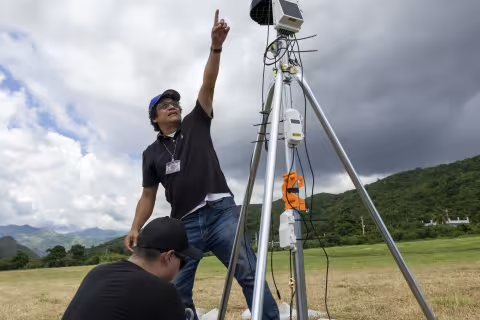
Using real-time data from the New York State Mesonet, an advanced weather observation network operated by UAlbany, along with detailed local weather models, CLAUW researchers are studying how wind and temperature behave close to the ground to support the flight safety of these new aircraft.
The urban air mobility industry is projected to reach roughly half a trillion dollars in value over the next decade.
"This center was named intentionally, because we see real opportunities to lead research into the part of the atmosphere that most impacts people," said González-Cruz. "We hope the science we develop can support urban communities broadly, as well as the growing urban air mobility industry."
Collaboration and Workforce Development
Along with UAlbany's Atmospheric Sciences Research Center, CLAUW will collaborate with researchers at TruWeather Solutions (a weather data and analytics company developing FAA-compliant advanced weather services for autonomous air operations), Cornell Duffield College of Engineering and New York University.
The group plans to explore the joint creation of a Low Altitude Transport Consortium to support the transformation of urban air transportation.
Future collaboration is also expected with UAlbany's College of Nanotechnology, Science, and Engineering and the Department of Geography, Planning, and Sustainability.
"UAlbany’s research enterprise is driven by a commitment to solving complex, real-world challenges that power the economy of tomorrow," said UAlbany Vice President for Research & Economic Development Kesh Kesavadas. "By addressing the scientific gaps in low-atmosphere weather prediction, CLAUW will position UAlbany not only to advance research in this space, but to stand at the forefront of the advanced air mobility sector."
The center is also planning to develop workforce training programs — and potentially new degree offerings — to help prepare New York and the nation’s workforce for urban air mobility technology.